

Project update: Wakefield Road Sustainable Travel Corridor
Following our public consultation and engagement undertaken between 4 March and 6 April 2025, we are providing an update on our A650 Connect proposals. Bradford Council, in partnership with the West Yorkshire Combined Authority, have been carefully reviewing all the feedback received on the proposals, which are now progressing further.
The Wakefield Road Sustainable Travel Corridor is a package of transport improvements proposed along the A650 Wakefield Road between Hall Lane and Dudley Hill Roundabout, and Tong Street between Dudley Hill Roundabout and Knowles Lane. The scheme forms part of wider A650 Connect proposals which includes a programme of improvements to Tong Street. While the Tong Street section is being progressed separately, both schemes contribute towards improving connections and travel options along this important route.
Feedback from residents, businesses and stakeholders, alongside technical assessments, road safety audits, traffic modelling and detailed design work, has informed the latest proposals.
Why is the scheme being proposed?
Wakefield Road is one of Bradford’s key transport corridors, carrying around 41,500 vehicles each day. It is a main route into and out of Bradford, linking the city centre with Leeds, Kirklees and the wider road network. Congestion can make journeys less reliable, particularly for bus passengers, while existing facilities for people walking, wheeling, cycling and public transport are limited in places and can be difficult to use. There are also areas where crossing the road can be challenging, with some existing subways feeling unwelcoming or inaccessible.
In communities along the corridor, many households do not have access to a car. Improving bus services and providing safer walking, wheeling and cycling routes will help ensure more people can access jobs, education and local services reliably.
The proposed improvements are intended to help reduce congestion pressures, improve journey time reliability, strengthen connections between communities and support a more dependable transport network, while helping to create a safer, more accessible and reliable corridor for everyone.
New bus priority measures and upgraded passenger facilities will help reduce delays, improve journey reliability and make bus travel a more attractive option.
Alongside this, improved walking, wheeling and cycling connections and safer crossing facilities will make it easier for people to access jobs, education, healthcare and local services. The scheme will also support more sustainable travel choices, contribute to wider environmental and public health objectives, and help accommodate future housing and employment growth across Bradford and surrounding areas.
The proposals
The scheme includes a range of improvements along the corridor, including:
Bus improvements
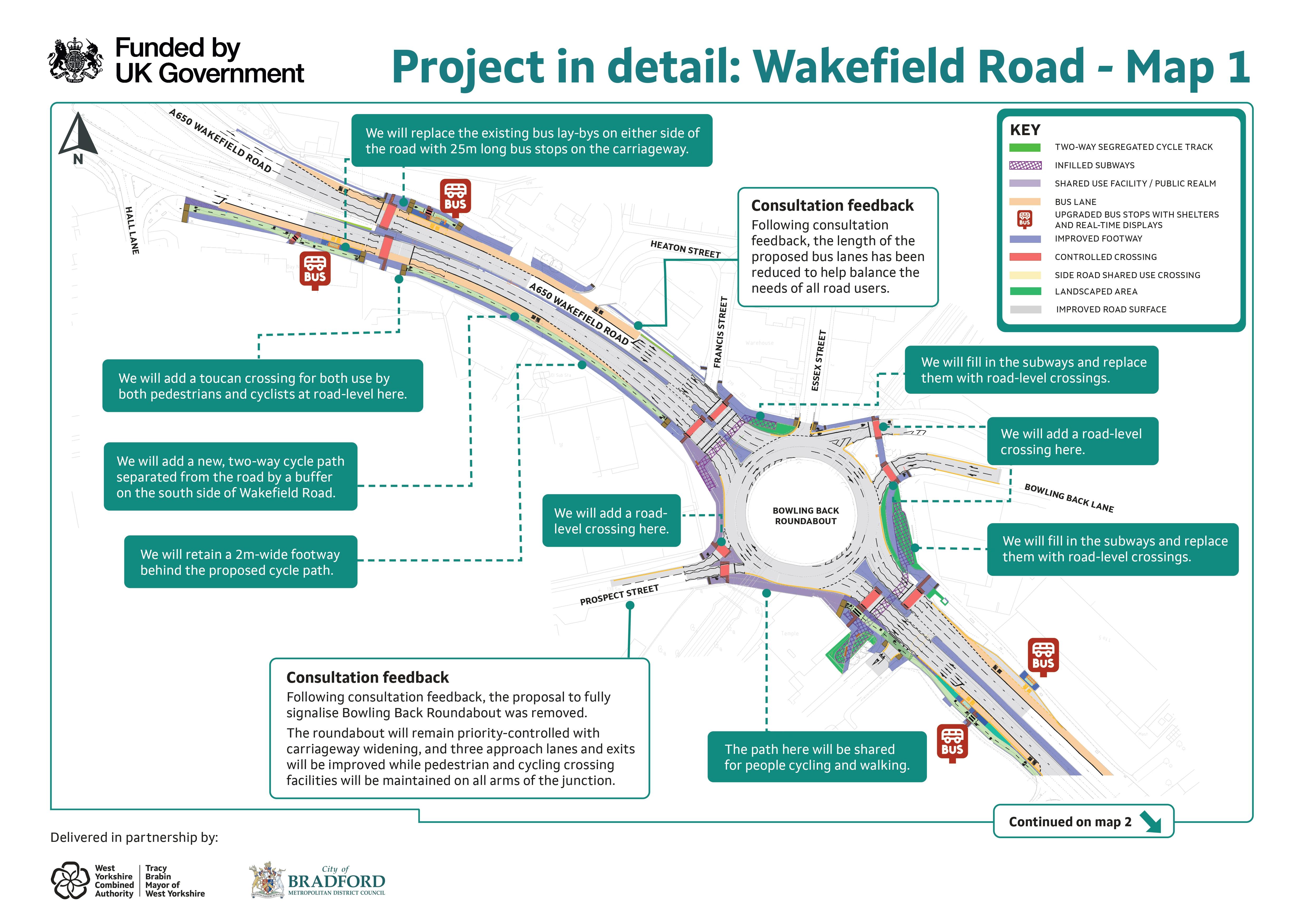
- Approximately 1.67km of peak-hour bus lanes.
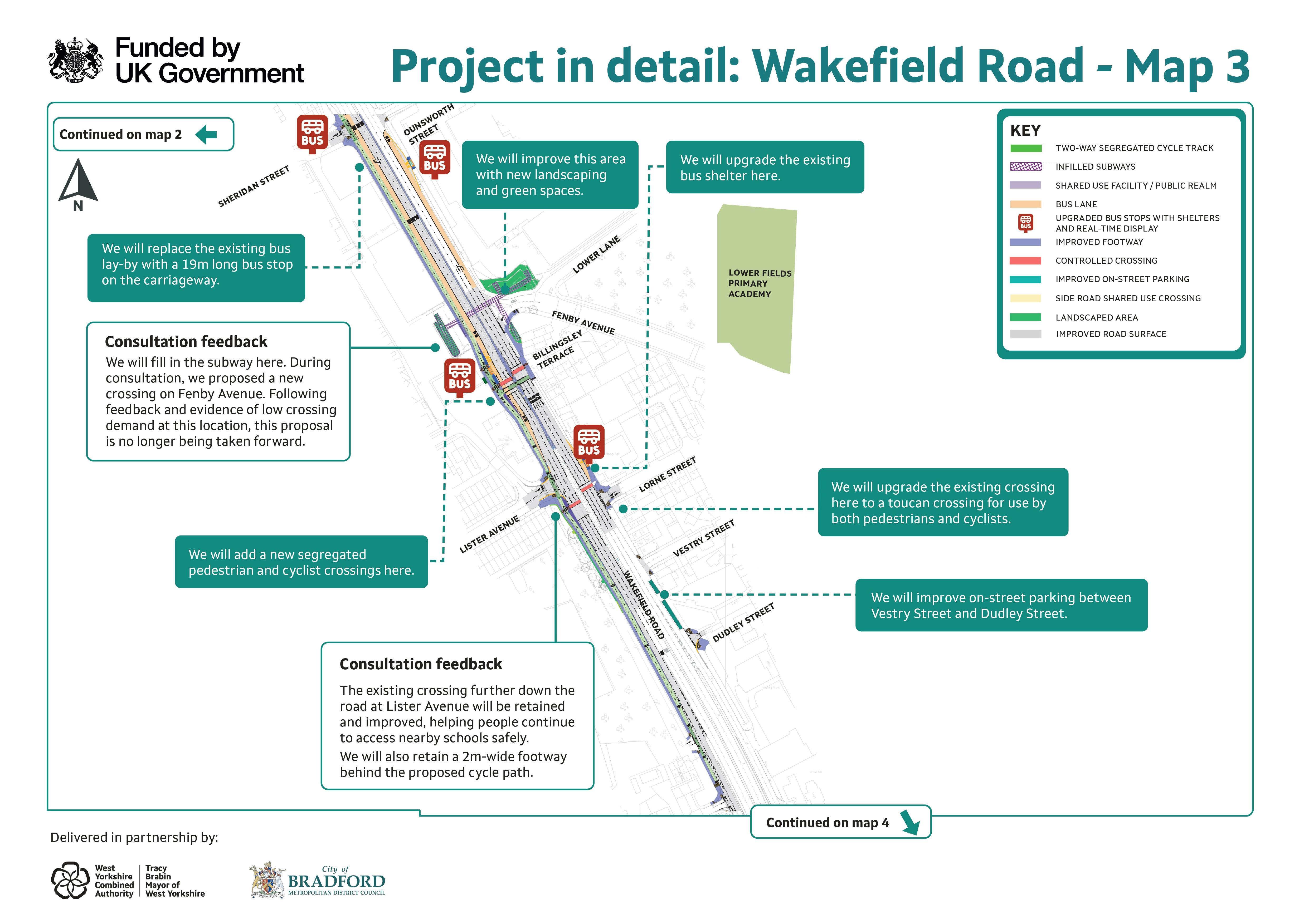
- Upgrades to 11 bus stops, including improved shelters, seating, lighting, CCTV and passenger information facilities.
Walking, wheeling and cycling improvements
- Approximately 1.9km of segregated bi-directional cycle lanes.
- Around 0.8km of shared-use walking and cycling facilities.
New and upgraded crossings
- Five new toucan crossings.
- Three new or upgraded parallel crossings.
- One new pelican crossing.
- One new zebra crossing.
- Upgrades to three existing crossings.
Subway removal
- Removal of four existing pedestrian subways.
- Replacement with new surface-level crossings designed to be more accessible, visible and welcoming.
Landscaping and public realm improvements
- Planting of 32 additional trees, resulting in a significant overall increase in tree cover.
- Wider landscaping and public realm enhancements to improve the appearance of the corridor.
- Removal of three existing trees to retain an existing pedestrian crossing and deliver wider scheme benefits.
You can view more detailed maps of our proposals, and the key changes made following feedback from local people here.
How have we responded to your feedback?
Feedback received during the 2025 consultation has directly influenced the development of the scheme. Alongside traffic modelling, road safety audits and technical assessment, comments from residents, businesses, transport operators and stakeholders have helped shape the latest proposals.
These changes include:
- Bowling Back Lane Roundabout will no longer be signalised. Traffic modelling showed that traffic lights at the roundabout would increase delays for road users. The roundabout will therefore remain priority controlled, while pedestrian and cycle crossing facilities will still be provided on each arm of the junction.
- The overall length of bus lanes has been reduced. Feedback from consultation and further traffic modelling indicated that continuous bus lanes were not required along the full route to deliver the intended benefits. As the design developed, the extent of bus lane provision was reviewed and refined. The total length of bus lanes has reduced from approximately 4.3km to 1.67km while retaining improvements to bus journey reliability.
- Bus lanes will operate during peak periods only. Feedback from the public, alongside further design development, identified an opportunity to reduce the impact of bus priority measures on general traffic while maintaining benefits for bus users. As a result, bus lanes that were originally proposed to operate 24 hours a day will now operate during peak periods only.
- Bus stop arrangements have been reviewed as the design developed. Feedback from bus operators, stakeholders and the public informed a review of bus stop provision, with the final proposals retaining upgraded bus stops while supporting reliable bus operations.
- The design has been amended to reduce impacts on mature trees. Surveys have informed the design process and enabled changes that reduce impacts on existing trees. While retaining an existing pedestrian crossing will require the removal of three trees, the scheme includes the planting of 32 new trees and additional landscaping, resulting in a significant overall increase in tree cover and supporting wider biodiversity enhancement objectives.
The scheme has completed public consultation and progressed through Outline Business Case (OBC) development. Feedback received through consultation has helped inform the scheme proposals and business case development.
The next stage will involve progressing the scheme towards Full Business Case (FBC) approval. During this stage, the design will continue to be refined while engagement with stakeholders, representative groups and key partners continues
Subject to approval of the Full Business Case and funding arrangements, construction is currently anticipated to start in early 2027 and complete in early 2028. Further updates will be provided as the project progresses.
Get in touch
If you have any questions on the project, you can get in touch with the team through the following channels:
- Email us at info@a650connect.com
- Call our freephone line at 0808 196 9119 (9am to 5pm Monday to Friday excluding bank holidays)
- Write to us at Freepost BFD Highways (no stamp needed)
Ask us questions:



-
 General project queries
- What is the Wakefield Road Sustainable Travel Corridor Scheme?
- Why are improvements needed along Wakefield Road?
- What are you proposing to do?
- How has feedback influenced the project - what changes have been made?
- What is the business case process?
- What stage is the project at?
- How is the scheme being funded?
- Why don’t you spend the money on something else?
- Will there be further engagement?
- Why are bus lanes needed?
- Why are you investing in cycle lanes?
-
Transport impact queries
- How will the scheme impact drivers?
- How will the scheme improve bus services?
- How will the scheme improve things for pedestrians?
- How will the scheme improve things for cyclists?
- Why are the subways being removed?
- How will the scheme support people with disabilities?
- Will the project result in any tree loss along the route?
- Will the project increase congestion?
-
Other queries
Thank you for your contribution!
Help us reach out to more people in the community
Share this with family and friends