Glossary
Type of improvement |
Definition |
Image |
|---|---|---|
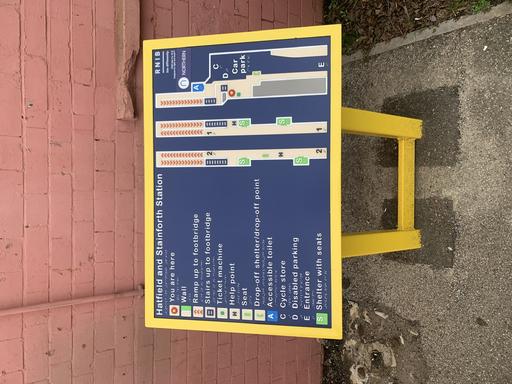
Braille Station maps |
A map that can be read through touch. The maps have raised areas that represent various features such as buildings and roads, and various forms of raised shading are used to represent land use. Braille is used for labels. |
|
Help Points |
Help points enable passengers to speak to a human operator where station staff are unavailable. Typically found on platforms or concourses, these points feature buttons for general assistance and an emergency line. |
|
Induction Loops |
Also referred to as Hearing Loops, Audio Frequency Induction Loops or AFILS, it is an audio technology whch supports improved hearing and communication for people with a hearing impairment. |
|
Direction signs to lifts, platforms and accessible routes |
Signs to provide instructions and guidance for navigating the station, acting as a tool for wayfinding that helps people find their way to a destination . |
|
Accessible facilities signs |
Signs to provide instructions to locate accessible facilities like accessible toilets. |
|
Accessible WC and baby change facilities |
A specially designed facility that provides space and features for people with disabilities to use the toilet safely. It may include facilities for changing babies. |
![]() ![]() |
Painted lines in car park |
Painted lines in car parks typically include clear, high-contrast markings that define parking bays, including dedicated accessible (Blue Badge) parking spaces, pedestrian walkways, crossing zones, and directional arrows for traffic flow.
How This Helps:
• Accessible Bays: Clearly marked accessible parking spaces (with appropriate width and proximity to station entrances) make it easier for disabled passengers to park and access the station safely.
• Visual Clarity: High-contrast markings help people with visual impairments or cognitive disabilities navigate the car park more easily.
• Improved Safety: Well-defined pedestrian zones and vehicle lanes reduce the risk of accidents involving vehicles and pedestrians.
|
|
Painted lines on footpaths in car park |
These are visual guides painted directly onto pedestrian walkways within the car park area, typically showing the path from car park spaces to station entrances or other key facilities.
How This Helps:
• Wayfinding: Helps all users—especially those with cognitive impairments or visual difficulties—follow a safe, designated route from their vehicle to the station.
• Separation from Traffic: Reinforces the division between pedestrian areas and vehicle movement zones, improving safety.
• Consistency: Helps create a logical, readable environment that supports those who benefit from predictable visual cues (e.g. people with autism).
|
|
Bike stands |
A device to which bicycles can be securely attached for parking purposes. It may be freestanding, or securely attached to the ground or a stationary object, such as a building. |
![]() |
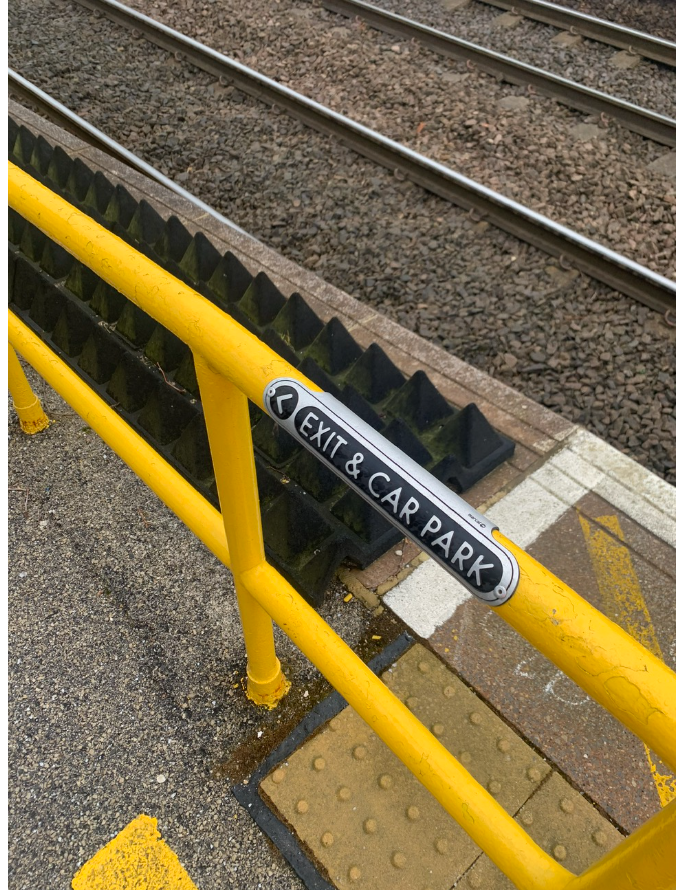
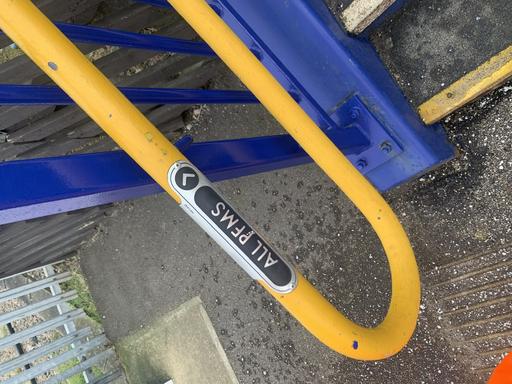
Handrails with Braille (directions, routes and level changes) |
A fixed rail for support that incorporates Braille instructions or guidance to navigate the station. |
![]()
|
Tactile paving (on stairs and ramps) |
Textured, raised ground surfaces designed to provide physical cues to blind and visually impaired people, helping them detect hazards like street crossings, stairs, and platform edges. |
|
Anti-slip stair edging |
Safety strips on the edge of stairs to prevent slipping. |
|
External pathway improvements |
Upgrades to the external pedestrian pathways around the station. This could be things like resurfacing uneven paths, installing dropped kerbs, adding tactile paving, improving drainage, widening paths, and ensuring your route is free from obstructions. |
|
Seats inside |
Areas to sit or rest inside. |
|
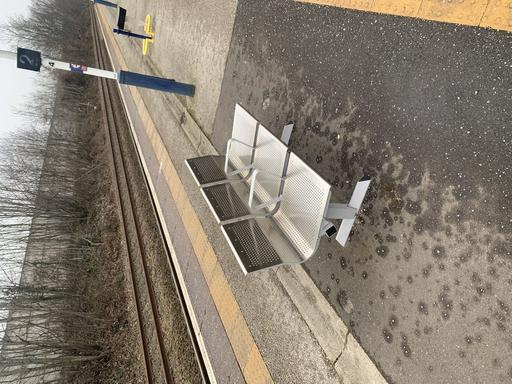
Seats outside |
Areas to sit or rest on the platform or other external area. |
![]() |
Furniture Painting |
Repainting or sealing furniture like seats to help with weatherproofing and to make the area a nice space to be. |
|
Tap Rails |
A horizontal rail installed at or near ground level for the benefit of visually impaired people. Blind or partially sighted people use a long cane to detect obstacles in their path, and the tapping rail serves as a detectable surface to alert them to the presence of a barrier. |
Share Glossary on Facebook
Share Glossary on Twitter
Share Glossary on Linkedin
Email Glossary link


Thank you for your contribution!
Help us reach out to more people in the community
Share this with family and friends